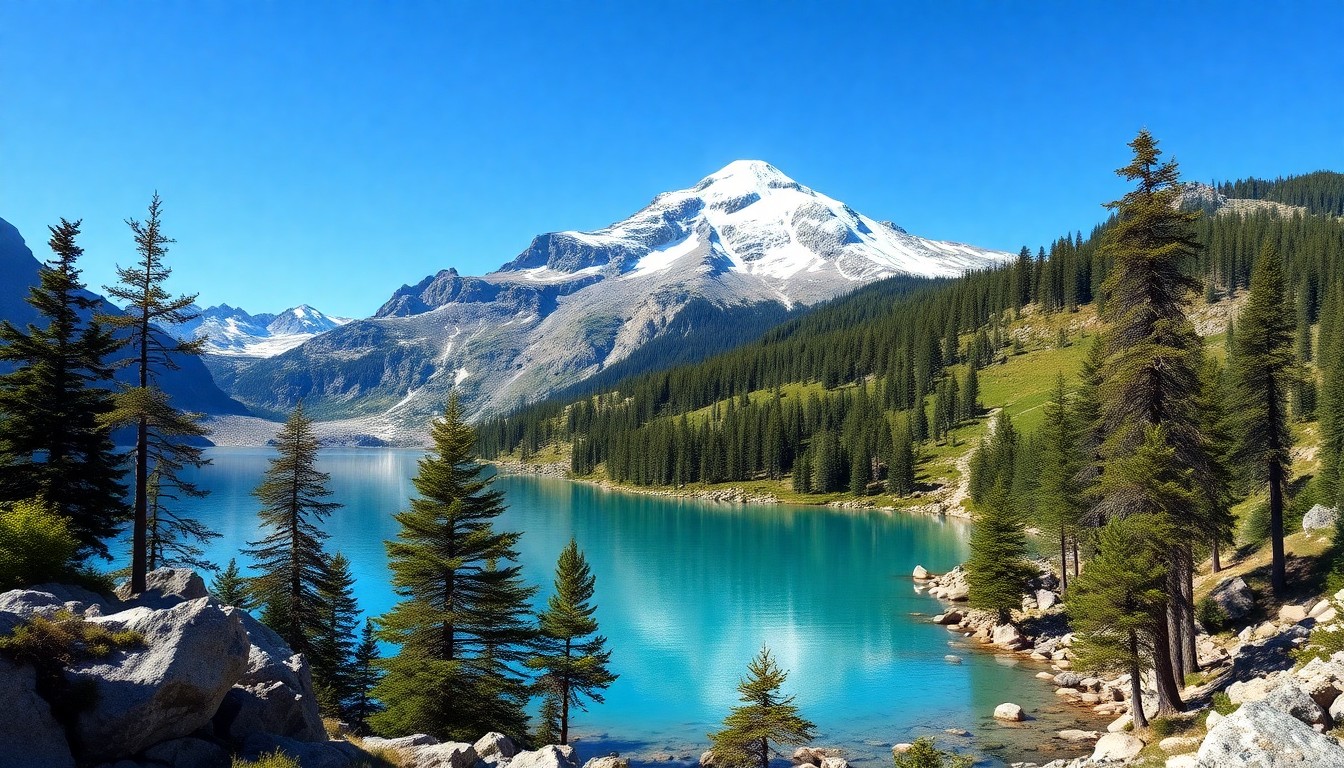
Lac de Gaube is one of those images that sum up the Pyrenees on their own: a sheet of dark water at 1,725 metres, ringed by mountain pines, and at the far end, due south, the north face of the Vignemale — 3,298 metres, the highest peak in the French Pyrenees, with its hanging glacier.
It is also one of the most accessible walks in the Cauterets valley, which explains its popularity. Here is what you should know before going up: how hard it really is, the cable car option, where to park, and what lies beyond the lake for those who want more.
Where Lac de Gaube is
The lake sits above the Pont d’Espagne, in the Cauterets valley, inside the core zone of the Pyrenees National Park (Hautes-Pyrénées).
Everything therefore starts from Cauterets, the spa and ski town that commands the valley. From the centre of Cauterets, a mountain road climbs to the Pont d’Espagne site, where the car park and the lifts are.
Getting there: parking and cable car
The Puntas car park
The car park at the Pont d’Espagne site (Puntas car park) charges a fee, and it is where your day is won or lost. In July, August and school holidays it is full by mid-morning. Arrive early, or take the shuttle from Cauterets when it runs.
On foot, or by lift?
Two options from the car park:
Entirely on foot. You first reach the Pont d’Espagne, then start the lake path. This is the most satisfying version, and the effort remains modest.
By cable car and chairlift. A gondola followed by a chairlift drops you considerably higher, cutting the walk down to a short stretch. This is what puts the lake within reach of almost anyone: older visitors, very young children, walkers who are not in training.
The lifts do not run all year and their hours change with the season. Check with the Cauterets tourist office before relying on them, especially outside July and August.
The walk from Pont d’Espagne to Lac de Gaube
This is the version most people are looking for.
- Start: Pont d’Espagne (~1,480 m)
- Finish: Lac de Gaube (~1,725 m)
- Ascent: about 250 m
- Time: 45 minutes to 1 hour up
- Difficulty: easy to moderate
- Waymarking: this is the GR10; you cannot get lost
How hard it really is, without dressing it up. The ascent is small and the path is short, but it is not smooth: it is a rocky mountain path with stone steps and tree roots, and it turns slippery in the wet. This is not a lakeside promenade — proper walking shoes are necessary, and trainers are a bad idea.
That said, six- and seven-year-olds manage it perfectly well. Simply allow twice the time with them.
Once up, a path circles the lake. Take the time to walk to the southern end: that is where the view of the Vignemale opens up fully, and where the crowd thins out.
The Hôtellerie du Lac de Gaube, on the shore, serves food and drink facing the whole scene.
Going further: the Oulettes de Gaube refuge
The lake need not be the end of it. If you have the day in front of you, what comes next is magnificent and far quieter.
The path continues due south up the Gaube valley, climbing gently, and reaches the Refuge des Oulettes de Gaube (2,151 m), planted directly opposite the north face of the Vignemale. Allow roughly two hours from the lake, on a well-made path (still the GR10).
What you come up here for is the face-to-face with one of the finest walls in the Pyrenees, and a glacial valley of unexpected breadth. Most people stop at the lake; nobody who climbs to the Oulettes regrets it.
Allow a full day for the round trip from Pont d’Espagne. You can sleep at the refuge (booking essential) and push on to more ambitious routes from there.
Lac de Gaube in winter
In winter the lake becomes a different place. It freezes, the valley turns white, and the crowds vanish.
Access is then on snowshoes from Pont d’Espagne — a classic and rewarding route on moderate terrain. The gondola may run as part of the Pont d’Espagne nordic area, but check: the opening periods do not cover the whole winter.
Two warnings worth stating plainly: the summer path is icy in places (light crampons transform the day), and avalanche risk exists on the slopes above the valley. Read the bulletin before you set off.
Swimming, wild camping, dogs: National Park rules
The lake lies in the core zone of the Pyrenees National Park. The rules there are strict, and they are enforced.
Swimming. Let us be honest: the water in Lac de Gaube is glacial. It barely passes 10 °C at the height of summer. This is not a swim, it is cold shock. Every year people jump in and regret it instantly.
Dogs are banned, even on a lead, throughout the Park’s core zone. It is the rule that surprises visitors most, and it is enforced. Make other arrangements for your dog.
Wild camping (bivouac) is subject to specific Park regulations — a minimum distance from road access, and evening-to-morning only. Do not set off with a tent without checking the current conditions with the Park visitor centre.
Fires, plant picking and drones: prohibited.
When to go
- June: the streams are full, the vegetation erupts, and there is room to breathe. Check that snow has cleared from the path.
- July–August: the busiest window. The lake is superb, but leave at dawn.
- September–October: our preference. Low light, slopes turning russet, empty trails.
- Winter: on snowshoes, for an entirely different mountain.
Where to stay
The obvious base is Cauterets: hotels, thermal baths, shops, and the start of the Pont d’Espagne road. You can string together Lac de Gaube, the Pont d’Espagne and the Marcadau valley without ever spending long in the car.
To sleep at altitude, the Refuge des Oulettes de Gaube offers the strongest experience of all, facing the Vignemale.
Nearby
The Cirque de Gavarnie is an hour’s drive away and plays in a similar league: another valley, another geology, the same punch to the chest. If you are building a walking trip in the area, the two combine perfectly, and the GR10 links them.
Frequently asked questions
Is Lac de Gaube hard to reach? No. From Pont d’Espagne it is 250 m of ascent and under an hour’s walk. The path is simply rocky: walking shoes are essential.
Can I take a cable car? Yes. A gondola followed by a chairlift greatly shortens the walk from the car park, which makes the lake accessible to those with limited mobility. Opening periods vary, so check first.
How high is the lake? About 1,725 metres.
Can you swim in it? The water barely exceeds 10 °C, even in August. Technically possible; deeply unpleasant.
Can I bring my dog? No. Dogs are banned in the core zone of the Pyrenees National Park, even on a lead.
How long to the Oulettes refuge? About two hours from the lake, making a full day round trip from Pont d’Espagne.